
KEY TAKEAWAYS
- FXSwap introduces automated liquidity concentration for volatile asset pairs, enhancing AMM performance.
- The refueling mechanism in FXSwap subsidizes rebalancing costs, maintaining liquidity without active management.
- Pangea’s analysis shows FXSwap offers better execution for large trades compared to Uniswap V3, especially during volatility.
The introduction of Stableswap in 2020 demonstrated the effectiveness of passively concentrated liquidity for pegged assets, such as USDC<>USDT and WETH<>stETH. However, for volatile asset pairs with independent prices, Automated Market Maker (AMM) performance remains a challenge. FXSwap aims to address this by automating liquidity concentration and introducing a new mechanism called refueling.
FXSwap, Curve’s new AMM, is designed for asset pairs that drift over time rather than forming stable pairs. This includes both volatile crypto assets and lower-volatility foreign exchange and real-world asset pairs. The system combines the pricing efficiency of Stableswap with the passive rebalancing framework of Cryptoswap, along with the refueling mechanism. The goal is to provide deep, passive liquidity for asset pairs that are not pegged to each other, eliminating the need for liquidity providers (LPs) to actively manage ranges.
How FXSwap Enhances Liquidity Management
FXSwap automates the process of keeping liquidity concentrated near the current market price. This addresses a common issue in volatile AMMs, where liquidity often drifts away from the active price, leading to higher slippage for traders and lower fee capture for LPs. Unlike Concentrated Liquidity AMMs (CLAMMs) like Uniswap V3, where LPs must manually reposition liquidity, FXSwap automates this process using pool trading fees and the refueling mechanism.
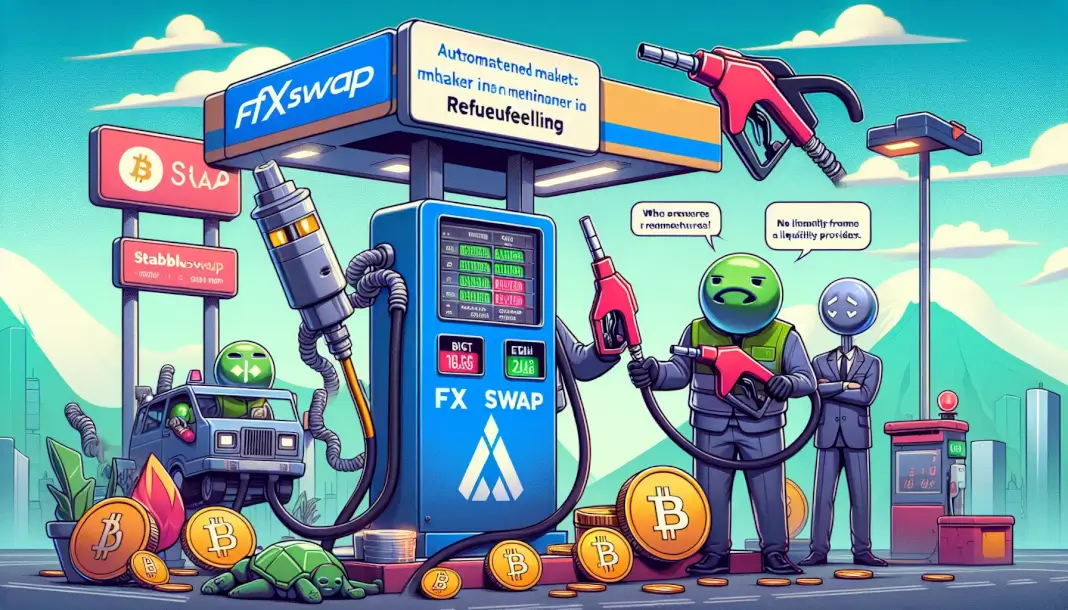
The refueling mechanism acts as an external buffer, subsidizing rebalancing costs during both calm and volatile markets. This ensures that liquidity remains in range and consistently earns fees without active management. FXSwap is particularly suited for pairs such as BTC/USD and ETH/USD, as well as low-volatility assets like fiat FX stablecoins.
Pangea’s Analysis of FXSwap Performance
Pangea conducted an independent analysis comparing FXSwap to Uniswap V3 for BTC/USD flows. The study found that FXSwap can deliver materially better execution for large trades, especially during periods of volatility. For smaller trades, Uniswap often performed slightly better due to lower fees, as FXSwap pools use a static 1% fee to fund automatic liquidity management and refueling.
During a significant market movement on November 21, when BTC fell below $83,000, both pools temporarily lost liquidity concentration. However, FXSwap’s automated refueling mechanism allowed it to quickly regain liquidity concentration, unlike Uniswap, which relies on manual LP intervention. Pangea’s analysis suggests that FXSwap represents a meaningful advance in volatile AMM design, providing deeper execution for large trades without requiring LP micromanagement.
For more detailed insights, Pangea’s full study is available here.
Why This Matters: Impact, Industry Trends & Expert Insights
FXSwap introduces automated liquidity management for volatile asset pairs, aiming to improve AMM performance by automating liquidity concentration and introducing a mechanism called refueling.
Recent industry reports indicate that automated liquidity management is increasingly driven by AI and agent-based systems. FXSwap’s automation aligns with this trend, aiming to enhance liquidity management in volatile markets by automating processes that traditionally required manual intervention.
As per insights from The Trade, FXSwap is seen as a structural innovation that could improve capital efficiency and workflow automation in FX markets. This supports the potential impact of FXSwap in making AMMs more viable for large-scale liquidity in FX markets.
Explore More News:
Disclaimer: The views expressed in this article are those of the authors and do not necessarily reflect the official policy of CoinsHolder. Content, including that generated with the help of AI, is for informational purposes only and is not intended as legal, financial, or professional advice. Readers should do their research before taking any actions related to the company and carry full responsibility for their decisions.

