
KEY TAKEAWAYS
- Tether Data’s QVAC division released QVAC Genesis II, expanding its AI training dataset to 148 billion tokens across 19 domains.
- The new dataset introduces Option-Level Reasoning, enhancing clarity and decision-making in AI training.
- QVAC’s open release supports decentralized AI research, promoting understanding over imitation.
On December 22, 2025, Tether Data’s AI research division, QVAC, announced the release of QVAC Genesis II, a significant expansion of the world’s largest publicly available synthetic educational dataset for artificial intelligence pre-training. The new release adds 107 billion tokens, bringing the total to 148 billion tokens across 19 educational domains. This expansion significantly enhances the scale, depth, and reasoning quality of open AI training data.
QVAC Genesis II builds upon the foundation of QVAC Genesis I, which introduced a rigorously validated, education-focused synthetic dataset covering core STEM disciplines. The latest release extends coverage to 10 new domains, including chemistry, computer science, statistics, machine learning, astronomy, geography, econometrics, and electrical engineering. Additionally, it regenerates college-level physics using an improved methodology. Together, Genesis I and II form the most comprehensive synthetic educational dataset ever released to the public.
Innovative Data Generation Approach
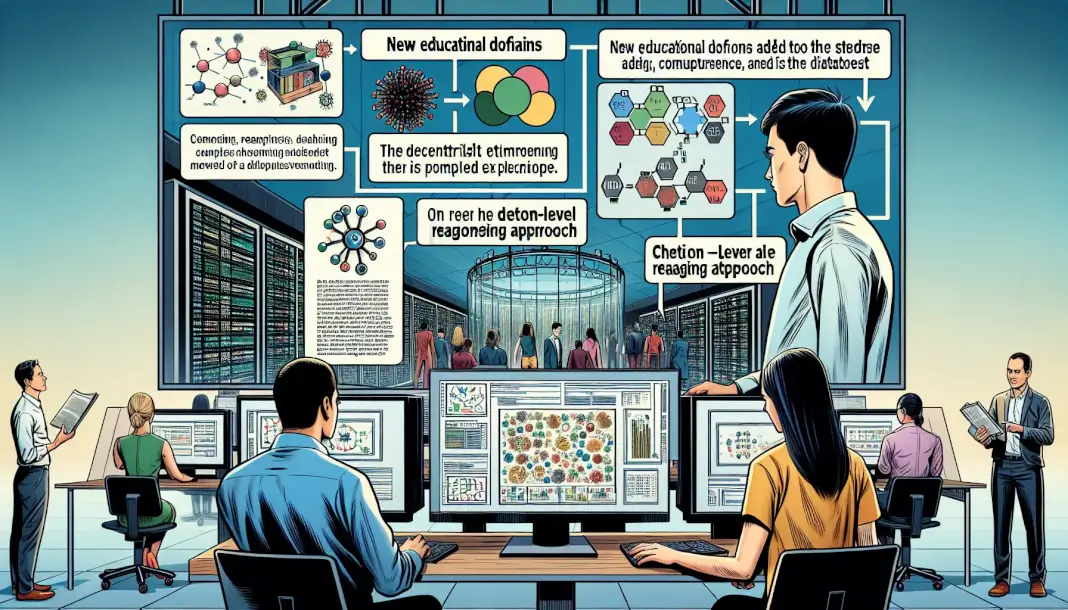
At the core of this release is a new data generation approach called Option-Level Reasoning. This method is designed to extract structured reasoning not only from model failures but also from correct answers. Instead of treating correct responses as finished outputs, the approach systematically analyzes every answer option in a multiple-choice question, reinforcing correct reasoning while explicitly addressing common misconceptions. This results in training data that emphasizes clarity, causality, and decision-making, rather than just surface-level correctness.
This new approach complements the original Failure Analysis method introduced in Genesis I, forming a dual-method pipeline that ensures every generated question contributes educational value. Independent evaluations show that models trained on Genesis II data demonstrate substantially higher reasoning accuracy and produce clear, unambiguous answers more consistently than models trained on prior synthetic datasets.
Commitment to Open AI Research
QVAC’s approach reflects a deliberate shift in how educational AI data should be built. While much of the industry focuses on scraping and aggregating larger volumes of text, QVAC aims to teach models how to think, reason, and explain, grounding intelligence in understanding rather than imitation. Paolo Ardoino, CEO of Tether, stated, “With this release, we’re pushing beyond volume toward structure, reasoning, and clarity. Intelligence should be built on understanding why something is true, not just predicting what sounds right.”
The expanded dataset is released openly to support researchers, academic institutions, and independent developers working outside of closed, proprietary systems. It is available under a Creative Commons Attribution–NonCommercial (CC-BY-NC 4.0) license, reinforcing QVAC’s commitment to open, community-driven AI research. This release continues QVAC’s broader mission to advance local, decentralized intelligence, where AI models can be trained, refined, and deployed without dependence on centralized cloud platforms.
The full technical breakdown of the dataset, titled “QVAC Genesis II: Expanding the Largest and Highest-Quality Multi-domain Educational Synthetic Dataset for Pre-training,” is available now via the QVAC research blog, alongside access to the dataset and models on Hugging Face.
Why This Matters: Impact, Industry Trends & Expert Insights
Tether’s QVAC Genesis II release significantly expands its synthetic educational dataset to 148 billion tokens, enhancing AI training data’s scale and depth across various educational domains.
According to a Stanford AI Index report, trends in AI educational datasets emphasize rapid growth in dataset scale for training AI models, with datasets doubling every eight months. This aligns with Tether’s expansion, which significantly increases the available data for AI model training in education.
Recent insights from Lumenalta indicate advancements in AI reasoning methodologies, including neural-symbolic AI hybrids and probabilistic reasoning models. This supports the impact of Tether’s new Option-Level Reasoning method in its dataset, which enhances AI’s reasoning capabilities and decision-making processes.
Explore More News:
Disclaimer: The views expressed in this article are those of the authors and do not necessarily reflect the official policy of CoinsHolder. Content, including that generated with the help of AI, is for informational purposes only and is not intended as legal, financial, or professional advice. Readers should do their research before taking any actions related to the company and carry full responsibility for their decisions.

